We hope this newsletter finds you well. For those of you in the northern parts of the country, we hope you are enjoying the arrival of summer weather.

As we have communicated in the past, we continue to collaborate with the National Retiree Legislative Network (NRLN) on issues that affect all of us but require a national effort beyond FCA US. As a member of the NCRO, you are also a member of the NRLN. Recently, our President, Jay Kuhnie, joined Bill Kadereit, President of the NRLN, and Alyson Parker, NRLN’s Washington Director, to meet with Congressional Committee members’ staffs. They advocated pension derisking issues, where companies transfer their pension obligations to insurance companies through the purchase of annuities, eliminating pensioners’ ERISA protection. We are advocating for reinsurance that would provide 100% protection in case of the insurance company’s insolvency. Additionally, they discuss the future funding of Social Security and issues related to Medicare. We will update you on the results of our activities in future communications.

We are very appreciative of and thankful for your continued support. If you have any issues or need assistance, please contact us at nc*********@**ro.org.


Update on February Tri-Annual Meeting

Over the years, we have held either quarterly or tri-annual meetings, hearing from various aspects of the automotive industry. This includes corporate executives within Chrysler/FCA, automotive experts from the media and research, and other experts in the field of protecting seniors and retirees. However, we have not yet heard from our amazing dealer body.

To address this, the NCRO invited Bill Golling from the Detroit Metro area, one of Chrysler/FCA/Stellantis’ largest and most successful dealers, to speak to us. He provided his perspective on the history of the business and his thoughts on its current state and future direction.

Bill shared his personal history and how he became part of the business, starting as a young man working for his father, who founded the Golling dealerships. Over the years, Bill has expanded the business to include many dealerships with several different automotive brands and franchises. He is now transitioning the management of the dealerships to his two sons.

Bill provided excellent insights into the world of dealers, specifically what they have faced over the past several years since the beginning of Stellantis. He also discussed the positive changes made by the newly appointed management in recent months. Additionally, Bill shared interesting insights into the electrification of the automotive business, its impact on dealers’ short-term and long-term business, and the financial implications for dealerships.

If you were unable to attend the meeting, we encourage you to view it along with other meeting videos on Youtube at https://youtube.com/@thencro.


Aging Information Committee

The NCRO Aging Information Committee held a webinar on March 18th at 11 AM EST, covering Assisted Living Choices with speaker Justine Bykowski. We are exploring other topics for future webinars, so keep checking our page on NCRO.org. Also, visit our website for our new blog on Aging Issues, which is well worth a visit.

We hope everyone is doing great. If you have questions, please email us at Ag***@**ro.org


Request for Possible NCRO Board Members

Since its inception in 2008, the activities of the NCRO have been directed by a Board of Directors. Currently, our Board consists of an exceptional group of 20 members, most of whom have served for over 10 years, some since the inception of the NCRO.

All organizations need to develop a succession plan, and the NCRO is no different. We are looking for individuals who might be interested in serving as a member of the Board. Our current Board is made up of individuals from all areas and levels within the automotive industry, which we believe contributes to our success.

If you are interested in serving on the Board, please contact Jay Kuhnie, President, at ja*******@**ro.org.  Upon receiving your interest, he will contact you to discuss the Board and its activities. Remember, this is a volunteer organization that can provide a tremendous amount of satisfaction working for our retirees.


Insurance Committee Update

Filing Claims with Via Benefits Accounts (VBA)

In December, the NCRO’s Insurance Committee provided a 90-minute webinar presented by experts from Via Benefits Accounts (VBA), which is now posted on the NCRO’s website. The presentation covered claims filing for reimbursements from the Healthcare Retirement Account (HRA) and the Retiree Health Care Account (RHCA).

You can access the presentation and video from the NCRO homepage: https://ncro.org. We encourage you to visit our website for all the information the NCRO provides its members.

Here is the direct link to the presentation:                                                                                             

https://ncro.org/wp-content/uploads/2024/12/FCA-VBA-Stellantis-NCRO-12-10-24-Deck-FINAL.pdf  

And here is the direct link to the video on the NCRO’s YouTube channel: https://www.youtube.com/watch?v=h9beKnywKr8

NOTE: If you have an issue with VBA or Benefit Connect (BC) that you cannot resolve directly with them, please send the NCRO Insurance Committee the details, and we may be able to help through our contacts in HR provided by FCA. Please send that information to the Insurance Committee at In****@**RO.org.


Patient Assistance Programs (PAP) for Drug Cost Relief

If you or someone you know is taking an expensive drug, you are aware that some biological medications can cost tens of thousands of dollars, potentially exceeding $100,000 annually, depending on insurance coverage. Insurance often covers much of this cost, but each plan (including Medicare Part D) can have rules and limits resulting in high out-of-pocket expenses. For those with Medicare Part D, the cost for 2025 is capped at $2,000, provided the drug is in the insured’s drug plan formulary.

Drug manufacturers understand that these prices are unaffordable for many Americans. As a result, most have created Patient Assistance Programs (PAPs) to assist individuals who find their prescribed drugs extremely expensive. The manufacturer may serve as either a secondary insurance plan to your regular drug insurance plan or bypass your insurance plan altogether, providing the medication free of charge or at a discount.

First, determine if the manufacturer of your medication has created a PAP. Your doctor’s office staff can help by applying to the manufacturer for you, but you may need to ask. They know which drug manufacturers have programs for the specific drugs prescribed. Alternatively, you can determine the manufacturer of your drug via the internet and contact them directly. Inquire if they have a PAP for patients, ask if you are eligible, and learn the steps to apply.

It is worth noting that not all PAPs have income limitations. Some are open to all users of the medications, with no income requirements whatsoever. However, under federal law, people covered by Medicare, Medicaid, or other federally funded insurance plans are not always eligible to enroll in these PAP programs. With the recent advent of the Medicare Part D $2,000 cap on drug costs, there may be less incentive for manufacturers to help. However, if you have a drug that is not in your insurer’s formulary (even after requesting an exception), the manufacturer might be more inclined to assist.

If someone cannot be covered under a PAP, there are charitable organizations that fund drug costs for various illnesses, primarily cancer. Manufacturers have lists of these charities. In some cases, if a charity has exhausted its funds for a particular drug or illness, the manufacturer may then cover the entire cost of the drug. Different manufacturers have varying policies.

The manufacturer’s PAPs are extremely knowledgeable about the ins and outs of all types of coverage available. Be proactive and call them; they will direct you. They are your best source of information and assistance. However, beware of scam websites that want to charge a monthly fee to provide you with your drug at a discount or for free. Ensure you are visiting the manufacturer’s website.

These medications are expensive, but help is available. Be persistent and willing to investigate all the resources available.


Who is the NCRO’s Insurance Committee (IC)?

We are a group of fellow retired NCRO members who wanted to understand more about our own retiree benefits to help ourselves and our fellow retirees. Formed about 15 years ago, we now have seven members from MI, OH, and IN who can assist you when you encounter roadblocks with the normal FCA channels of Via Benefits Accounts (VBA) and Benefit Connect (BC). The IC has helped several hundred fellow retirees, both directly with the benefits knowledge we have gained and by using the FCA contacts provided to us in FCA’s Health Care, Pensions, and other retiree benefits departments. On the NCRO.org website, we provide content for the tabs Health Insurances, Reimbursements, and Pension/Soc Sec. We also sponsor and hold webinars on these topics. If you hit a roadblock following your normal VBA and BC channels, you can email us the details to see if we can help at In****@**RO.org.

Your Personal Invite to an Important NCRO Webinar

On Thursday, September 11th at 9:30 AM, the Insurance Committee of the NCRO will again present “Medicare 101: Information for Pre-65 and 65+”, our annual webinar that focuses on issues of importance to all retirees (and their spouses).

While this webinar is designed for those retirees (and/or spouses) who are getting ready to enroll in Medicare (ages 62-64), it also provides very valuable information for those who are already 65+ and currently on Medicare. You need not be a member of NCRO to participate in this free webinar.

The agenda includes speakers on:

  • Overviews – Social Security, Medicare and Medical Insurance
  •  Understanding Medicare Advantage and Medicare Supplemental Plans (Medigap Plans)
  • Break
  • Understanding Medicare Part D Rx Drugs
  • An Introduction to your Retiree Health Care Account (RHCA). Healthcare Retirement Account (HRA), & Via Benefits Accounts (VBA)
  • Healthcare Consultants Available for your Decision Making
  • Questions and Answers

Please click on this link to register for the WEBINAR.

After registering, you will receive a confirmation email which will contain information on how to join the webinar.
It is anticipated that the webinar will last approximately 3½ hours and end around 1:00 pm.

Registration is now open (see above). In mid-August, you will be receiving an announcement/registration email, at which time, you will also be able to register by going to the NCRO website at NCRO.org.


2025 CY Membership Dues

Reminder: Calendar Year 2025 Annual Dues (01-01-2025 through 12-31-2025) invoices were mailed at the beginning of November 2024. The $25 annual dues were to be paid by December 31, 2024. If you have already paid your 2025 Calendar Year Dues, you will not receive a dues notice. Second dues reminders were sent in March 2025 for those who haven’t paid their dues.

We also ask that you encourage your retiree friends who are not NCRO members to join our efforts by becoming members of NCRO.

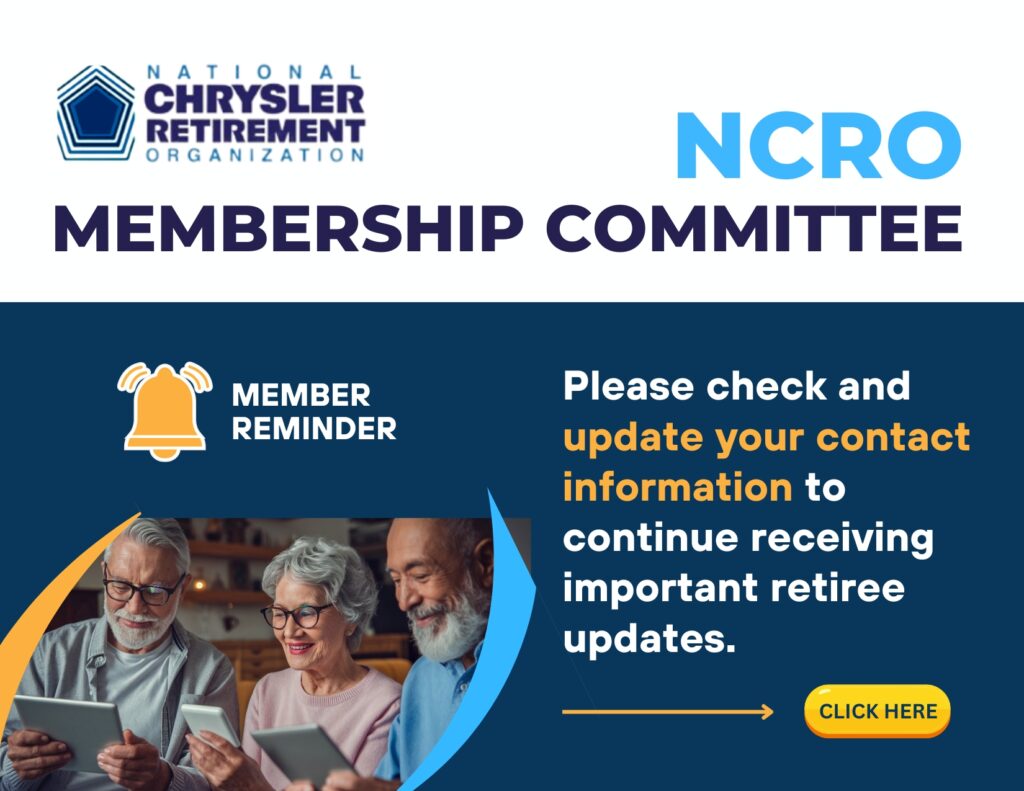
Reminder to Check/Update Your Information for the NCRO

To ensure that NCRO can provide you with the latest communications, newsletters, benefits, and company ownership updates, please check and update your information in the NCRO database.

Regarding Membership Information in the NCRO Database:

There is no linkage between Stellantis and NCRO databases. If you update FCA with any changes to your home address, email address, or phone numbers, these changes do not get to NCRO. You need to update both Stellantis and NCRO separately.

  1. Email Address: If you no longer have an email address, the only means for NCRO to provide you with written communications is through your mailing address. If it is not correct in the NCRO database, you will not receive any communications from NCRO. Please keep your address in the database current.
  2. Snowbirds: Many of you may travel to a warmer climate for the winter months. We cannot keep two mailing addresses for you in our database. Please provide NCRO with one main mailing address to send NCRO communications.
  3. Payment Addresses: All 2024 Calendar Year payment addresses will be reviewed and compared to what is in the NCRO database. If you are using the NCRO website to make payment for breakfast meetings or dues, please take the time to review your information in the database and correct it if required.
  4. Caregiver Address: If you are living with a caregiver, please use the caregiver’s address in the database.

Please go to the NCRO website (www.ncro.org) under the “NCRO Members” tab and check to see that your correct address and/or email address is on file. It also may be incorrect in FCA’s database. So, update both NCRO and Stellantis with any changes in address and/or phone number. Make that update at https://fcabenefits.ehr.com. Click on My Profile and on View/Edit to see your current information and make any needed changes. If you have a problem updating your information in the NCRO database, please contact Pete Piccinato, and he will help to get it done. Pete’s email is: pp********@*****st.net


Retiree Friendly Dealer Program

We now have seven Detroit Metro dealers participating in the Retiree Friendly “no hassle” process for selling vehicles to retirees. You can also visit our website to review the list of retiree-friendly dealers and their contact information.

If you are in the market for a vehicle, contact one of the Retiree Friendly Dealers listed below to schedule an appointment. Please make sure that you contact the person identified for that dealer, as they understand the retiree-friendly dealer program. Also, remember the Chrysler Employee and Retiree Advantage Program. Control numbers are available for your use at https://www.ea.chrysler.com/EmpAdv/

Also, remember to use the Retiree Friendly Dealers for your service maintenance. If you go to one of the Retiree Friendly Dealers for maintenance, please let them know that you are a member of NCRO. This will let the dealers know that NCRO members are supporting them since these dealers are supporting NCRO.

Participating Dealers:

Birmingham:

Bloomfield Hills:

Rochester Hills:

Warren:

Chelsea:

Roseville:

Auto Tech Tips

The NCRO has added a section to our website for members to ask questions about issues with their Stellantis vehicles. Once we receive a question, it will be submitted to one of our retiree-friendly dealers. The response will be posted on the website, and a separate email will be sent to the individual who asked the question. Our retiree-friendly dealers support this process. Please be aware that some issues may eventually require a visit to the dealership service department to be resolved.


2K views
0 FacebookLinkedinCopy LinkEmail

2025 CY Membership Dues

Reminder: Calendar Year 2025 Annual Dues (01-01-2025 through 12-31-2025) invoices were mailed at the beginning of November 2024. The $25 annual dues were to be paid by December 31, 2024. If you have already paid your 2025 Calendar Year Dues, you will not receive a dues notice. Second dues reminders were sent in March 2025 for those who haven’t paid their dues.

We also ask that you encourage your retiree friends who are not NCRO members to join our efforts by becoming members of NCRO.

Reminder to Check/Update Your Information for the NCRO

To ensure that NCRO can provide you with the latest communications, newsletters, benefits, and company ownership updates, please check and update your information in the NCRO database.

Regarding Membership Information in the NCRO Database:

There is no linkage between Stellantis and NCRO databases. If you update FCA with any changes to your home address, email address, or phone numbers, these changes do not get to NCRO. You need to update both Stellantis and NCRO separately.

  • Email Address: If you no longer have an email address, the only means for NCRO to provide you with written communications is through your mailing address. If it is not correct in the NCRO database, you will not receive any communications from NCRO. Please keep your address in the database current.
  • Snowbirds: Many of you may travel to a warmer climate for the winter months. We cannot keep two mailing addresses for you in our database. Please provide NCRO with one main mailing address to send NCRO communications.
  • Payment Addresses: All 2024 Calendar Year payment addresses will be reviewed and compared to what is in the NCRO database. If you are using the NCRO website to make payment for breakfast meetings or dues, please take the time to review your information in the database and correct it if required.
  • Caregiver Address: If you are living with a caregiver, please use the caregiver’s address in the database.


Please go to the “NCRO Members” tab and check to see that your correct address and/or email address is on file. It also may be incorrect in FCA’s database. So, update both NCRO and Stellantis with any changes in address and/or phone number. Make that update at https://fcabenefits.ehr.com. Click on My Profile and on View/Edit to see your current information and make any needed changes. If you have a problem updating your information in the NCRO database, please contact Pete Piccinato, and he will help to get it done. Pete’s email is: pp********@*****st.net

1.9K views
0 FacebookLinkedinCopy LinkEmail

As we age, many of us notice changes in our senses—especially taste and smell. A favorite meal might not seem as flavorful as it once was, or the aroma of fresh coffee might not be as strong. But is this loss of taste and smell a normal part of aging, or could it signal something more serious?

For members of the National Chrysler Retirement Organization, understanding these changes can help maintain a healthy and enjoyable lifestyle. Let’s explore what’s normal, what’s not, and what you can do about it.

How Taste and Smell Work Together

Taste and smell are closely linked. When we eat, our taste buds detect basic flavors like sweet, salty, sour, bitter, and umami (savory). Meanwhile, our sense of smell adds complexity—helping us distinguish between vanilla and chocolate, or rosemary and thyme.

As we age, both senses naturally decline, but significant loss can affect nutrition, safety, and quality of life.

Is It Normal to Lose Taste and Smell with Age?

Some decline is expected. Research shows:

  • Taste buds shrink and regenerate more slowly after age 50, reducing sensitivity.
  • The sense of smell weakens due to nerve endings and reduced mucus production in the nose.
  • By age 80, nearly 75% of adults have some measurable smell loss.

However, complete or sudden loss is not normal and should be checked by a doctor.

Common Causes Beyond Aging

While gradual decline happens, other factors can worsen taste and smell loss:

  1. Medications – Blood pressure drugs, antihistamines, and some antidepressants can dull senses.
  2. Smoking – Damages taste buds and nasal passages.
  3. Chronic conditions – Diabetes, Parkinson’s, Alzheimer’s, and sinus issues can contribute.
  4. Dental problems – Gum disease or ill-fitting dentures affect taste.
  5. COVID-19 & other illnesses – Viral infections sometimes cause prolonged smell/taste loss.

Why It Matters

Losing these senses isn’t just frustrating—it can impact health:

  • Reduced appetite leading to malnutrition or weight loss.
  • Overusing salt or sugar to compensate, worsening blood pressure or diabetes.
  • Missing danger signals like spoiled food, gas leaks, or smoke.

What You Can Do

While some loss is inevitable, these steps can help:

1. Enhance Flavors Naturally

  • Use herbs, spices, citrus, and umami-rich foods (tomatoes, mushrooms, aged cheese).
  • Try varying textures and temperatures to make meals more interesting.

2. Stay Hydrated

  • Dry mouth dulls taste—drink water and chew sugar-free gum to stimulate saliva.

3. Check Medications

  • Ask your doctor if any prescriptions could be affecting your senses.

4. Quit Smoking

  • Stopping smoking can gradually improve taste and smell.

5. Practice Smell Training

  • Sniff strong scents (like lemon, cloves, or eucalyptus) daily to help retrain the nose.

6. See a Specialist

  • An ENT (ear, nose, and throat doctor) or neurologist can check for underlying issues.

When to Seek Help

Consult a doctor if you experience:

✔ Sudden loss of taste/smell
✔ Persistent changes without a cold or allergy
✔ Accompanying symptoms like headaches, nasal congestion, or memory issues

The Bottom Line

Mild decline in taste and smell is a normal part of aging, but severe or rapid loss is not. By staying aware and making small adjustments, you can continue enjoying food, staying safe, and maintaining a high quality of life.

For more health tips and resources, stay connected with the Aging Committee of the National Chrysler Retirement Organization. We’re here to support you in living your best years!

01
Content Generated with AI...

...with Edits and Modifications

At NCRO, we are proud to uphold the highest standards of accuracy and quality in all our content. Our articles are meticulously crafted by advanced AI technology, rigorously reviewed, and approved by our dedicated NCRO committees before being shared on our website. This thorough process ensures that our readers receive reliable and credible information they can trust.
2.5K views
0 FacebookLinkedinCopy LinkEmail

Traveling abroad is an exciting experience, but managing your money wisely can make or break your trip. One of the biggest questions retirees and travelers face is: Should I exchange currency before I leave, or should I rely on ATMs at my destination?

For members of the National Chrysler Retirement Organization (NCRO), making informed financial decisions is key to enjoying a stress-free retirement. Let’s break down the pros and cons of each option so you can decide what’s best for your next adventure.

Option 1: Exchanging Currency Before You Travel

Exchanging money before your trip means visiting a bank, credit union, or currency exchange service to get foreign cash in advance.

Pros:

✔ Convenience – You arrive with local currency, avoiding the hassle of finding an ATM right away.
✔ Budget Control – You know exactly how much you’ve converted, helping you stick to a spending plan.
✔ Avoid Airport Fees – Airport exchange kiosks often have poor rates; getting cash beforehand can save money.

Cons:

❌ Less Competitive Rates – Banks and exchange services may charge higher fees or offer worse rates than ATMs abroad.
❌ Risk of Loss or Theft – Carrying large amounts of cash makes you a target for pickpockets.
❌ Leftover Currency – If you don’t spend it all, you may lose money converting it back.

Best For:

  • Travelers visiting countries where cash is still king (like Japan or smaller towns in Europe).

  • Those who prefer having money ready upon arrival.


Option 2: Using ATMs Abroad

Withdrawing local currency from ATMs at your destination is often the most cost-effective method.

Pros:

✔ Better Exchange Rates – ATMs usually offer rates close to the interbank rate (the best available).
✔ Convenience – ATMs are widely available in most tourist destinations.
✔ Safety – You carry less cash at once, reducing theft risk.

Cons:

❌ ATM Fees – Your bank and the foreign ATM may charge withdrawal fees (though some banks reimburse these).
❌ Foreign Transaction Fees – Some banks charge an extra 1-3% per withdrawal.
❌ Potential Card Issues – Your card could be blocked if you don’t notify your bank of travel plans.

Best For:

  • Travelers visiting countries with strong banking systems (Europe, Australia, Canada).

  • Those who prefer not to carry large sums of cash.


Tips to Save Money on Foreign Currency

  1. Choose the Right Bank – Some banks (like Charles Schwab or Capital One) reimburse ATM fees and don’t charge foreign transaction fees.

  2. Avoid Dynamic Currency Conversion (DCC) – When using a card abroad, always choose to pay in the local currency, not USD, to avoid extra fees.

  3. Notify Your Bank – Prevent your card from being frozen by alerting your bank about your travel plans.

  4. Carry a Backup Card – Have a second debit or credit card in case one gets lost or blocked.

  5. Mix Both Methods – Exchange a small amount before leaving for immediate expenses, then use ATMs for the rest.

Notify your bank or credit card company before traveling!

One crucial step many travelers overlook is notifying their bank or credit card company before traveling. If your financial institution detects foreign transactions without prior notice, they may freeze your card for suspected fraud—leaving you without access to funds at a critical moment. A quick call or online alert to your bank can prevent this hassle. Most banks allow you to set travel notifications through their app or website, specifying your destination and travel dates. This simple precaution ensures smooth transactions abroad, so you can focus on enjoying your trip rather than resolving card issues.


Final Verdict: ATMs Usually Win

For most travelers, withdrawing cash from ATMs abroad is the smarter choice due to better exchange rates and convenience. However, having a small amount of local currency before arrival can ease stress, especially in cash-heavy destinations.

As an NCRO member, you’ve worked hard for your retirement—make sure your travel money strategy keeps more cash in your pocket for the experiences that matter!

Safe travels and happy adventures!

01
Content Generated with AI...

...with Edits and Modifications

At NCRO, we are proud to uphold the highest standards of accuracy and quality in all our content. Our articles are meticulously crafted by advanced AI technology, rigorously reviewed, and approved by our dedicated NCRO committees before being shared on our website. This thorough process ensures that our readers receive reliable and credible information they can trust.
3.9K views
2 FacebookLinkedinCopy LinkEmail
Aging is an inevitable and natural part of life, but understanding the changes your body goes through can make all the difference in maintaining your health, independence, and quality of life. While some shifts are simply part of growing older, others may signal underlying health issues that need attention.
 
As part of the National Chrysler Retiree Organization’s Aging Information Committee, we’re committed to helping you navigate these changes with confidence. By learning what’s considered normal—and what might require a closer look—you can stay proactive about your well-being, make informed decisions, and continue enjoying an active, fulfilling lifestyle. Let’s explore the key differences between typical age-related changes and potential red flags you shouldn’t ignore.
 

Normal Changes vs. Red Flags

✅ Normal: Occasional forgetfulness, like misplacing keys or briefly struggling to recall a name, is common. Mild slowing in processing speed is also typical.
 
🚩 Not Normal: Frequent memory lapses, confusion about time/place, difficulty completing familiar tasks, or personality changes could indicate dementia or other conditions.
 
Tip: Stay mentally active with puzzles, reading, or learning new skills. If memory issues interfere with daily life, see a doctor.
✅ Normal: Some stiffness in the morning, mild joint discomfort, or slightly reduced flexibility are expected.
 
🚩 Not Normal: Severe pain, swelling, or joint deformities could signal arthritis. Sudden balance problems or falls may indicate neurological or cardiovascular issues.
 
Tip: Regular low-impact exercise (walking, swimming) helps maintain mobility. Persistent pain should be evaluated.
✅ Normal: Needing reading glasses (presbyopia), slight hearing loss (especially high-pitched sounds), or mild cataracts are typical.
 
🚩 Not Normal: Sudden vision loss, dark spots, or extreme sensitivity to light may indicate serious eye conditions. Significant hearing loss or tinnitus (ringing in ears) should be checked.
 
Tip: Get annual vision and hearing exams. Early intervention can prevent further decline.
✅ Normal: Older adults may sleep lighter, wake earlier, or need slightly less sleep (6-7 hours).
 
🚩 Not Normal: Chronic insomnia, frequent nighttime urination, or excessive daytime fatigue could point to sleep apnea, diabetes, or other health issues.
 
Tip: Maintain a consistent sleep schedule and limit caffeine/alcohol before bed. Discuss persistent sleep problems with a doctor.
✅ Normal: A slower metabolism may lead to gradual weight gain if diet/exercise habits don’t adjust. Muscle mass naturally decreases (sarcopenia).
 
🚩 Not Normal: Sudden, unexplained weight loss could signal illness (e.g., thyroid issues, cancer, or depression).
 
Tip: Strength training helps preserve muscle. Report significant weight changes to your physician.
✅ Normal: Arteries stiffen slightly with age, possibly causing higher (but still manageable) blood pressure.
 
🚩 Not Normal: Chest pain, shortness of breath, or extreme fatigue with minimal activity may indicate heart disease.
 
Tip: Monitor blood pressure regularly. A heart-healthy diet and exercise are key.
 
✅ Normal: Occasional sadness or stress is part of life. Adjusting to retirement or life changes takes time.
 
🚩 Not Normal: Prolonged sadness, loss of interest in activities, or social withdrawal may signal depression.
 
Tip: Stay socially connected. Seek help if low moods persist.

Final Thoughts

Aging brings changes, but many can be managed with healthy habits and regular check-ups. Knowing what’s normal—and when to seek help—empowers you to live your best life.
 
The National Chrysler Retiree Organization’s Aging Information Committee is here to support you. Have questions or concerns? Reach out—we’re in this together!


Disclaimer: This blog is for informational purposes only. Always consult a healthcare professional for medical advice.
01
Content Generated with AI...

...with Edits and Modifications

At NCRO, we are proud to uphold the highest standards of accuracy and quality in all our content. Our articles are meticulously crafted by advanced AI technology, rigorously reviewed, and approved by our dedicated NCRO committees before being shared on our website. This thorough process ensures that our readers receive reliable and credible information they can trust.
2.7K views
2 FacebookLinkedinCopy LinkEmail
For many retirees, navigating health insurance coverage can be a frustrating and time-consuming process. Delays in approvals, confusing denials, and excessive paperwork have long been pain points for policyholders—especially seniors who rely on timely medical care. However, recent announcements from major health insurers suggest that positive changes may be on the horizon.
 
In response to growing complaints and regulatory pressure, several leading insurance companies have pledged to streamline their prior authorization processes and improve transparency in coverage decisions. For Chrysler retirees and other seniors, these reforms could mean faster access to necessary treatments and fewer bureaucratic hurdles.
 

The Problem: Excessive Delays and Denials

Prior authorization—a process where insurers require pre-approval before covering certain medications, procedures, or treatments—has been a major source of frustration. While designed to control costs and prevent unnecessary care, the system often leads to:
  • Treatment delays – Patients, including those with chronic conditions, sometimes wait weeks for approvals.
  • Increased administrative burden – Doctors’ offices spend excessive time submitting paperwork and appealing denials.
  • Unexpected out-of-pocket costs – When claims are denied, retirees may face steep bills or forgo care altogether.
A 2022 report from the U.S. Department of Health and Human Services (HHS) found that Medicare Advantage plans denied over 2 million prior authorization requests in a single year—with many rejections later overturned on appeal.
 

Insurers’ Promises to Improve the System

Recognizing these challenges, major insurers—including UnitedHealthcare, Aetna, and Humana—have announced reforms aimed at reducing delays and improving patient experiences. Key changes include:
 
1. Faster Response Times
Some insurers are committing to shorter turnaround times for urgent and routine requests. For example:
  • 24-hour decisions for urgent care cases
  • 72-hour decisions for standard requests (down from the current 5-14 day average)
2. Reducing Unnecessary Prior Authorization Requirements
Certain insurers are eliminating prior authorization for common services, such as:
  • Routine imaging (e.g., MRIs, CT scans)
  • Physical therapy sessions
  • Select prescription medications
3. Increased Transparency
Patients and providers will have better access to:
  • Clearer denial explanations
  • Real-time status updates on authorization requests
  • Easier appeals processes
4. Greater Use of Technology
Automated systems and artificial intelligence (AI) are being tested to speed up approvals while reducing errors.
 

What Retirees Should Do Now

While these changes are promising, it may take time before all improvements are fully implemented. In the meantime, retirees can take proactive steps to minimize coverage hassles:
  1. Review Your Plan’s Rules – Understand which services require prior authorization.
  2. Keep Detailed Records – Save all correspondence with insurers and healthcare providers.
  3. Appeal Denials Promptly – Many rejections are overturned upon appeal.
  4. Stay Informed – Follow updates from Medicare, your insurer, and advocacy groups like the National Chrysler Retiree Organization.

The Bottom Line

Health insurers’ commitments to improving prior authorization are a step in the right direction. If implemented effectively, these changes could reduce stress for retirees and ensure quicker access to necessary care. However, vigilance is still key—hold insurers accountable, ask questions, and advocate for your healthcare rights.
 
For more updates on retiree healthcare benefits and advocacy efforts, stay connected with the National Chrysler Retiree Organization. Together, we can work toward a smoother, fairer healthcare system for all retirees.

A sample letter to write to medicare.gov on a denied claim.

[Your Name]
[Your Address]
[City, State, ZIP Code]
[Your Phone Number]
[Your Medicare Number]

[Date]

Medicare Appeals
Medicare - [Your Medicare Contractor’s Name, if known]
[Address, if available]

OR Submit online at: [Medicare.gov Appeals Page]

Subject: Appeal of Denied Claim – [Claim Number/Service Date]

Dear Medicare Appeals Department,

I am writing to formally appeal the denial of my claim for [briefly describe the service or item denied, e.g., "a knee MRI performed on [date] at [facility name]"]. The reason for denial stated was [quote the denial reason from your Medicare Summary Notice (MSN), e.g., "service deemed not medically necessary"]. However, I believe this decision was made in error for the following reasons:

1. Medical Necessity – My physician, [Dr. Name], determined this service was essential for diagnosing/treating my condition, [briefly explain, e.g., "chronic knee pain unresponsive to prior treatments"]. Attached is a supporting letter from my doctor.
2. Prior Authorization – [If applicable, mention if prior authorization was obtained or if the provider assured coverage.]
3. Medicare Coverage Rules – This service appears to meet Medicare’s coverage criteria under [cite policy if known, e.g., "Medicare Policy Manual Section XYZ"].
4.Enclosed Documentation (copies, not originals):

*Medicare Summary Notice (MSN) showing the denial
*Doctor’s letter/medical records supporting necessity
*Any prior authorization or referral forms
*Other relevant correspondence

I respectfully request a redetermination of this claim and ask that you reconsider your decision. Please contact me at [your phone number] if additional information is needed. I appreciate your prompt attention to this matter.

Sincerely,

[Your Signature]

[Your Printed Name]

[Your Name]
[Your Address]
[City, State, ZIP Code]
[Your Phone Number]
[Your Medicare Number]

[Date]

Medicare Appeals
Medicare - [Your Medicare Contractor’s Name, if known]
[Address, if available]

OR Submit online at: [Medicare.gov Appeals Page]

Subject: Appeal of Denied Claim – [Claim Number/Service Date]

Dear Medicare Appeals Department,

I am writing to formally appeal the denial of my claim for [briefly describe the service or item denied, e.g., "a knee MRI performed on [date] at [facility name]"]. The reason for denial stated was [quote the denial reason from your Medicare Summary Notice (MSN), e.g., "service deemed not medically necessary"]. However, I believe this decision was made in error for the following reasons:

1. Medical Necessity – My physician, [Dr. Name], determined this service was essential for diagnosing/treating my condition, [briefly explain, e.g., "chronic knee pain unresponsive to prior treatments"]. Attached is a supporting letter from my doctor.
2. Prior Authorization – [If applicable, mention if prior authorization was obtained or if the provider assured coverage.]
3. Medicare Coverage Rules – This service appears to meet Medicare’s coverage criteria under [cite policy if known, e.g., "Medicare Policy Manual Section XYZ"].
4.Enclosed Documentation (copies, not originals):

*Medicare Summary Notice (MSN) showing the denial
*Doctor’s letter/medical records supporting necessity
*Any prior authorization or referral forms
*Other relevant correspondence

I respectfully request a redetermination of this claim and ask that you reconsider your decision. Please contact me at [your phone number] if additional information is needed. I appreciate your prompt attention to this matter.

Sincerely,

[Your Signature]

[Your Printed Name]

Notes:

  • Deadline: You must file this appeal within 120 days of the denial date on your MSN.
  • Tracking: Send via certified mail (if submitting by mail) and keep copies of all documents.
  • Next Steps: If this appeal is denied, you have further appeal rights (reconsideration, hearing, etc.).
Need Help? Contact your State Health Insurance Assistance Program (SHIP) at 1-877-839-2675 or www.shiphelp.org.
01
Content Generated with AI...

...with Edits and Modifications

At NCRO, we are proud to uphold the highest standards of accuracy and quality in all our content. This article was meticulously crafted by advanced AI technology, rigorously reviewed, and approved as modified by our dedicated NCRO IC Committee before being shared in this email and on our website.
2.7K views
1 FacebookLinkedinCopy LinkEmail

Benefit links and information provided by Stellantis / FCA

Seniors, be sure to use the link above to "Check Your Benefits"!

BenefitsCheckUp® connects millions of older adults and people with disabilities with benefits programs that can help pay for health care, medicine, food, utilities, and more. See what's available in your area by entering your ZIP code when prompted.

11.1K views
0 FacebookLinkedinCopy LinkEmail
For decades, Florida has reigned supreme as the premier retirement destination: warm weather, no income tax, and a deep infrastructure geared to retirees. But today, a striking shift is underway. Retirees are increasingly turning away from the Sunshine State, drawn instead to lesser-known locales that offer affordability, quality of life, and vibrant community life. Two standouts are West Virginia and New Mexico—each offering unique benefits that challenge conventional retirement wisdom.

 
1. West Virginia: Serene, Affordable, and Culturally Rich
Charleston, West Virginia’s capital, is quietly emerging as an unexpected retirement haven. Nestled in the scenic Appalachian Mountains, Charleston brings together affordability, access to health care, and cultural depth. According to FinanceBuzz, it “offers scenic mountain living with big‑city conveniences” like arts, dining, and outdoor recreation—all at housing costs among the lowest in the South forbes.com+15financebuzz.com+15mypocket.news+15.
 
Notably, West Virginia plans to phase out taxes on Social Security income by 2026, making it financially favorable for seniors financebuzz.com. Combined with the tranquil environment and strong community networks found in small to mid‑size towns, this trajectory has already led to demographic growth and boosts to local services tailored for seniors.
Veterans and retirees benefit from proximity to VA facilities, and the region’s mild four‑season climate invites a slower pace along rivers, forests, and gentle mountain trails. Unlike the competitive real estate in Florida, Charleston and its surroundings remain accessible, allowing retirees to age in place with dignity and comfort.

 
2. New Mexico: Historic Charm, Low Costs, and Rich Culture
New Mexico is attracting retirees with its cultural cachet, dry climate, and cost efficiency. According to Nasdaq, the state ranks among the top retirement destinations receiving growing interest for 2025—alongside Arizona and North Carolina. Forbes highlights cities like Santa Fe and Las Cruces as “unexpected hot spots,” combining affordability with cultural amenities nypost.com+8forbes.com+8patch.com+8.
 
In particular, Las Vegas, New Mexico, stands out. As Investopedia notes, this small town offers a median home price well below the national average—with stunning historic architecture, nearby national forests, and a tight‑knit community atmosphere that supports active aging investopedia.com. Santa Fe also scores high on walkability, arts scenes, and health care density—appealing features for those seeking purposeful, connected lives beyond their careers.
 
New Mexico’s desert climate is another plus—its low humidity can ease arthritis symptoms and generally support healthier living. With no additional tax burdens on Social Security or most pension income, retirees can optimize their financial resources while enjoying accessible cultural experiences, from Native American art to local cuisine and outdoor adventuring.

 
Why These States Are Gaining Ground Over Florida
  1. Escalating Costs and Crowding in Florida
    While Florida remains popular, rising housing costs, natural disaster risks, and increasing congestion are driving retirees elsewhere kiplinger.com+15kiplinger.com+15nasdaq.com+15 investopedia.com+4businessinsider.com+4thisismoney.co.uk+4 people.com+1thisismoney.co.uk+1.
  2. Tax Friendliness and Financial Freedom
    Both West Virginia and New Mexico offer robust tax incentives—from retirement income exemptions to low property taxes—enhancing retirees’ standard of living on fixed incomes.
  3. Healthcare & Community Accessibility
    Access to primary care, VA facilities, and slower‑paced yet culturally vibrant communities make both destinations favorable for aging in place.
  4. Lifestyle & Connection
    In West Virginia, retirees enjoy the serene support of Appalachian small towns, while New Mexico offers cultural immersion amid scenic landscapes—neither overstimulating nor isolating.
 
Top 10 Benefits of Retiring in West Virginia and New Mexico
  1. Low Cost of Living
    Both states offer significantly lower housing and everyday living expenses compared to national averages—ideal for seniors on fixed incomes.
  2. Improving Tax Benefits for Retirees
    • West Virginia is phasing out state taxes on Social Security income.
    • New Mexico has expanded exemptions for seniors on retirement income, including pensions and IRAs.
  3. Access to Quality Healthcare
    Both states feature respected hospital networks and are investing in expanding rural healthcare access. Santa Fe and Charleston offer excellent medical facilities for seniors.
  4. Mild, Manageable Climates
    • West Virginia has four distinct but gentle seasons, without Florida’s hurricane threats.
    • New Mexico offers dry, low-humidity air that can benefit those with respiratory or joint issues.
  5. Scenic Beauty and Outdoor Recreation
    From the Appalachian Mountains to the high deserts of the Southwest, these states encourage active lifestyles—walking trails, hiking, fishing, and birdwatching are all popular.
  6. Cultural and Historical Richness
    • New Mexico is a hub of Native American, Hispanic, and Anglo culture with arts festivals, cuisine, and traditional crafts.
    • West Virginia boasts strong Appalachian music, storytelling, and local fairs that foster community and belonging.
  7. Tight-Knit, Supportive Communities
    Smaller towns in both states provide a slower pace of life, low crime rates, and stronger neighborly connections—helpful for seniors seeking social ties and peace of mind.
  8. Affordable, Accessible Housing
    Whether buying or renting, seniors can find charming homes well below national market prices, many with walkable access to shops, healthcare, and churches.
  9. Growing Senior-Friendly Infrastructure
    Local governments and nonprofits are increasingly offering services like public transport, meal programs, and senior centers in both urban and rural areas.
  10. Less Congestion, More Tranquility
    Unlike crowded, fast-growing retiree hubs like Florida, both states offer quieter living with less traffic, noise, and overdevelopment—perfect for a peaceful retirement.
01
Content Generated with AI...

...with Edits and Modifications

At NCRO, we are proud to uphold the highest standards of accuracy and quality in all our content. Our articles are meticulously crafted by advanced AI technology, rigorously reviewed, and approved by our dedicated NCRO committees before being shared on our website. This thorough process ensures that our readers receive reliable and credible information they can trust.
2.8K views
2 FacebookLinkedinCopy LinkEmail

The Call That Cost $42,000”

Derek Mathis, a cautious small business owner, never expected to be scammed. One morning, he received an urgent email from his accountant—or so he thought—asking him to confirm a $42,000 wire transfer. At the bottom was a phone number to call his bank if he had concerns.

Suspicious but in a rush, Derek called the number. A calm, professional voice claimed to be with the bank’s fraud department. They asked for his full name, account details, and phone number to “secure” his account.

In reality, the email was fake, and the call routed to scammers. Using the info Derek provided, they performed a SIM swap—convincing his phone carrier to transfer his number to a new SIM in their control. Derek’s phone lost service shortly after.

With access to his texts and authentication codes, the scammers quickly drained $42,000 from his account. By the time Derek contacted his real bank, the money was gone.

Looks real, steals for real — always verify before you trust.

Protecting Your Email from Browser-Based Hacking

Email accounts are prime targets for cybercriminals, especially when accessed through web browsers (like Chrome, Safari, or Edge). Hackers use phishing, malware, and browser vulnerabilities to steal login credentials and personal information. Here’s how to keep your email secure:
 

Common Email Hacking Risks via Browsers

  1. Phishing Attacks
    • Fake login pages mimicking Gmail, Yahoo, or Outlook trick users into entering passwords.
    • Always check the URL before logging in—look for “https://” and the correct domain (e.g., mail.google.com).
  2. Malicious Browser Extensions
    • Some extensions secretly capture keystrokes (including passwords).
    • Only install extensions from official stores (Chrome Web Store, Apple App Store).
  3. Session Hijacking
    • If you stay logged in on a public computer, someone else could access your email.
    • Always log out after using email on shared devices.
  4. Keyloggers & Spyware
    • Malware can record everything you type, including passwords.
    • Use antivirus software and avoid downloading suspicious files.

How to Secure Your Email in Browsers

 
✅ Use Strong, Unique Passwords
  • Avoid simple passwords like “password123.” Use a mix of letters, numbers, and symbols.
  • Consider a password manager (like Bitwarden or 1Password) to store credentials securely.
✅ Enable Two-Factor Authentication (2FA)
  • Adds an extra step (e.g., a text code or authentication app) to verify your login.
  • Set up 2FA in your email account settings.
✅ Check for HTTPS & Browser Security
  • Never log in if the website lacks “https://” (the “s” means secure).
  • Look for a padlock icon in the address bar.
✅ Clear Browser Cache & Cookies Regularly
  • Stored data can be exploited. Go to browser settings and clear history/cookies periodically.
✅ Avoid Public Wi-Fi for Sensitive Logins
  • Hackers can intercept data on open networks. Use a VPN (like NordVPN or ProtonVPN) for added protection.
✅ Beware of Fake “Security Alert” Emails
  • Scammers send urgent warnings (e.g., “Your account has been locked!”) to steal logins.
  • Never click links in suspicious emails—log in directly through the official website.
Don't wait until it's too late. Take the right steps!

What to Do If Your Email Is Hacked

  • Change your password immediately.
  • Check for unauthorized forwarding rules (hackers often set up auto-forwarding).
  • Scan your device for malware using trusted antivirus software.
  • Notify contacts if spam is being sent from your account.

Final Reminder: Stay Alert & Update Often
Cyber threats evolve constantly, so staying cautious with emails, social media, and smartphones is key. Always verify suspicious messages, keep software updated, and use strong security measures.
 
Disclaimer: The tips provided are general recommendations and may vary based on your device, browser version, or email provider. For detailed guidance, consult official support resources from Google, Apple, or your email service. The National Chrysler Retiree Organization is not liable for any unauthorized access resulting from individual security practices.
 
Stay safe and secure online! 🛡️
01
Content Generated with AI...

...with Edits and Modifications

At NCRO, we are proud to uphold the highest standards of accuracy and quality in all our content. Our articles are meticulously crafted by advanced AI technology, rigorously reviewed, and approved by our dedicated NCRO committees before being shared on our website. This thorough process ensures that our readers receive reliable and credible information they can trust.
2.9K views
2 FacebookLinkedinCopy LinkEmail

Protecting Your Digital Life: Essential Cybersecurity Tips for Retirees

As valued members of the National Chrysler Retiree Organization, your online safety is our priority. In today’s connected world, retirees are increasingly targeted by sophisticated digital scams. This comprehensive guide covers six major threats you should know about, plus actionable steps to secure your devices and accounts.

6 Digital Threats Every Retiree Should Know

  1. Phishing Scams
    Fraudsters impersonate banks, family members, or former employers to steal login credentials. They often create urgency with messages like “Your account is locked!”
  2. Fake Giveaways & Contests
    Too-good-to-be-true offers promise prizes but require personal information or payments to “claim” them.
  3. Impostor Accounts
    Scammers create fake profiles of people you know, then message you with urgent financial requests.
  4. Romance Scams
    Criminals build online relationships, then fabricate emergencies to solicit money.
  5. Malware & Fake Links
    Disguised as shocking videos or important alerts, these install harmful software when clicked.
  6. Browser-Based Email Hacking
    Hackers target email accounts through:
    • Fake login pages that steal passwords
    • Malicious browser extensions
    • Session hijacking on public computers

Smartphone Protection Guide

General Tips for All Devices

  • Update Software Regularly: Enable automatic updates to patch security vulnerabilities.
  • Use Strong Passwords: Combine letters, numbers, and symbols. Avoid reusing passwords—consider a password manager.
  • Enable Two-Factor Authentication (2FA): Adds an extra layer of security for accounts like email or Facebook.
  • Avoid Public Wi-Fi: Hackers can intercept data on unsecured networks. Use a VPN if necessary.

Android-Specific Steps

  1. Restrict App Permissions: Go to Settings > Apps > Privacy to disable unnecessary access (e.g., location, microphone).
  2. Install Apps from Google Play Only: Avoid third-party stores. Enable Google Play Protect (Settings > Biometrics and Security) to scan for malware.
  3. Block Unknown Sources: Under Settings > Biometrics and Security > Install unknown apps, disable “Install unknown apps” to prevent malicious downloads.

iOS-Specific Steps

  1. Review App Tracking: Navigate to Settings > Privacy & Security > Tracking to limit ad tracking.
  2. Enable Find My iPhone: Activate in Settings > Tap on [Your Name] > Find My to remotely wipe data if your device is lost.
  3. Download from App Store Only: iOS restricts non-App Store downloads, reducing malware risks.

Stay Vigilant

  • Never share personal details (SSN, bank info) via social media.
  • Report scams to platforms like Facebook or the FTC.

Email Security Essentials

  • Always verify website URLs before logging in (look for “https://”)
  • Never save passwords in your browser
  • Clear cache/cookies regularly
  • Watch for phishing emails with urgent requests
  • Use a VPN on public networks

If Hacked:

  1. Change passwords immediately
  2. Check for unauthorized email forwarding rules
  3. Run antivirus scans
  4. Alert your contacts about potential spam

Stay Safe Online

Cyber threats constantly evolve, but knowledge is your best defense. Bookmark this guide, share it with friends, and always:

  • Think before clicking
  • Verify suspicious messages
  • Keep software updated
  • When in doubt, ask a tech-savvy family member

Disclaimer: Settings may vary by device model and software version. For device-specific guidance, consult official support resources. The NCRO is not responsible for individual security outcomes.

Stay informed, stay secure – because your safety matters to us!

01
Content Generated with AI...

...with Edits and Modifications

At NCRO, we are proud to uphold the highest standards of accuracy and quality in all our content. Our articles are meticulously crafted by advanced AI technology, rigorously reviewed, and approved by our dedicated NCRO committees before being shared on our website. This thorough process ensures that our readers receive reliable and credible information they can trust.
3K views
2 FacebookLinkedinCopy LinkEmail
National Chrysler Retirement Organization

This website uses cookies to improve your experience. We'll assume you're ok with this, but you can opt-out if you wish. Accept Read More