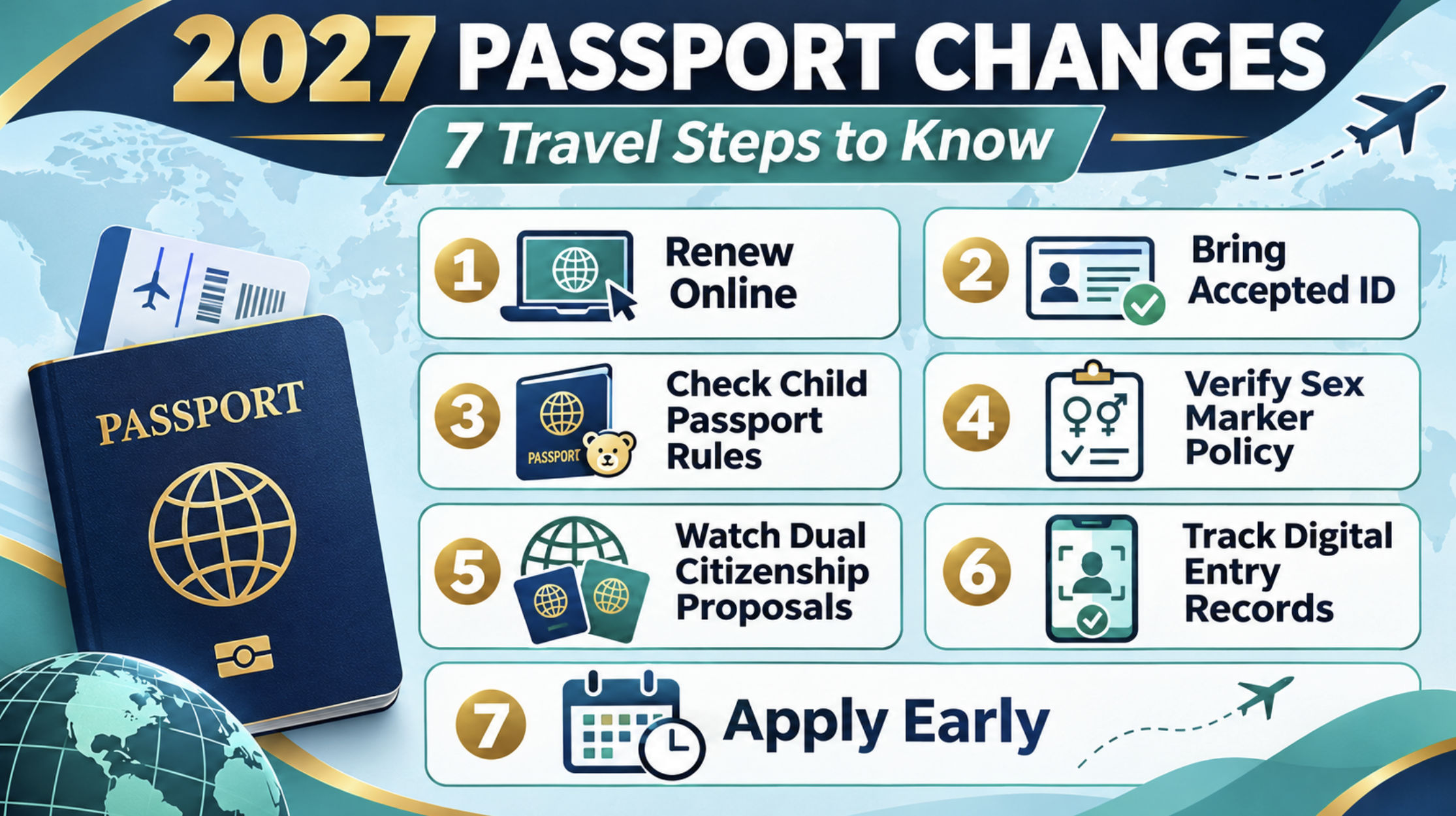
What’s changing, what’s already in effect, and what travelers need to do before their next international trip.
Planning to travel internationally in 2027? Whether you’re retiring abroad, visiting family overseas, or preparing for your next adventure, understanding U.S. passport and airport identification requirements is more important than ever.
Recent government policies, new airport procedures, and proposed legislation have generated plenty of headlines—and confusion.
But here’s what travelers need to understand: Not every proposed passport change has become law, and not every policy being discussed is new for 2027.
Let’s examine seven important issues, separate fact from speculation, and explain what you should do.
1. Online U.S. Passport Renewal Is Available
Status: Confirmed and already available.
The U.S. Department of State allows eligible American citizens to renew their passports online.
To qualify, you generally must be at least 25 years old, have a passport originally valid for 10 years, and be renewing a passport expiring within one year or one that expired less than five years ago.
You must also be physically located in a U.S. state or territory when applying. Online renewal is unavailable to applicants currently outside the United States.
What you should do
Check your passport expiration date before booking international travel.
If you’re eligible, use the official government portal at travel.state.gov.
If you live abroad, contact the nearest U.S. embassy or consulate for renewal instructions.
Important: Once you submit an online renewal, your existing passport is canceled for international travel. Don’t apply online immediately before an international trip.
2. Travelers Without Acceptable ID Face a $45 TSA Verification Fee
Status: Confirmed. Effective February 1, 2026.
Travelers aged 18 and older who arrive at TSA security checkpoints without a REAL ID-compliant driver’s license or another acceptable identification document can use a new verification option called TSA Confirm.ID.
The fee is $45 and covers a 10-day travel period.
However, paying does not guarantee that TSA will successfully verify your identity or allow you through security.
What you should do
Before traveling domestically, verify that you have one of the accepted identification documents:
-
-
REAL ID-compliant driver’s license
-
Valid U.S. passport or passport card
-
Global Entry or another approved trusted traveler card
-
Another form of identification accepted by TSA
-
If you have none, use the official TSA Confirm.ID payment process before arriving at the airport.
Save your payment receipt and allow extra time for identity verification.
The easiest solution is to travel with an accepted ID and avoid the $45 fee entirely.
3. Children’s Passports Have Special Rules
Status: Existing rules; no blanket cancellation confirmed.
Claims that children’s passports are being canceled in 2027 are misleading.
U.S. passports issued to children under age 16 remain valid for five years unless individually invalidated for a legally recognized reason.
Unlike eligible adult passports, children’s passports cannot simply be renewed online or by mail.
Parents must submit a new passport application in person, generally with both parents or guardians participating or providing the required documentation.
What you should do
Check each child’s passport expiration date before planning international travel.
Remember that some destinations require passports to remain valid for several months beyond the intended trip.
Parents concerned about international parental child abduction can enroll eligible children in the State Department’s Children’s Passport Issuance Alert Program.
This program provides notifications concerning passport applications but does not automatically cancel valid passports or prevent travel.
4. The U.S. No Longer Issues Passports With an X Sex Marker
Status: Confirmed; policy took effect beginning in 2025.
Under Executive Order 14168 and subsequent legal developments, the State Department currently issues passports displaying an M or F sex marker corresponding to the applicant’s sex at birth.
The Department no longer issues passports with an X marker or honors requests for a different sex designation based solely on personal attestation.
However, previously issued passports are not automatically canceled solely because they contain an X marker or a different designation.
What you should do
If your passport contains an X marker or a designation that may create difficulties during renewal or international travel, review the State Department’s current guidance before making changes.
Check the entry requirements of your destination country and ensure that your airline reservation matches your travel documents.
Travelers needing to replace or correct a passport should consult the State Department about the appropriate application form, fees, and supporting documentation.
5. The Exclusive Citizenship Act Could Affect Dual Nationals—If Enacted
Status: Proposed legislation, not an established 2027 requirement.
The Exclusive Citizenship Act of 2025 proposes significant restrictions on Americans holding citizenship in more than one country.
Under its proposed language, Americans who possess another citizenship would be required to choose which nationality to retain within a specified period after enactment.
That has understandably raised concerns among Americans living abroad, particularly retirees considering naturalization in another country.
But there is an essential distinction: A bill introduced in Congress is not automatically a law.
Under existing U.S. law, Americans generally may hold dual nationality without being required to surrender their U.S. citizenship.
What you should do
Do not renounce any citizenship based on alarming social media headlines.
If you already hold dual nationality or are considering acquiring it, monitor official congressional developments and consult a qualified nationality or immigration attorney before making irreversible decisions.
Also remember that U.S. citizens, including dual nationals, generally must enter and depart the United States using their U.S. passports.
6. Passport Stamps Are Becoming Less Common
Status: Partially true; no universal 2027 ban.
International border agencies increasingly use electronic arrival and departure systems rather than relying entirely on physical passport stamps.
In the United States, Customs and Border Protection already uses electronic Form I-94 records for many foreign visitors.
However, this does not mean every country has stopped stamping passports or that physical stamps have been universally eliminated.
Entry and exit procedures vary by country, nationality, and immigration status.
What you should do
Keep digital copies of your travel confirmations, boarding passes, and immigration documents.
Foreign visitors to the United States who receive an electronic I-94 can check their records through CBP’s official I-94 website.
When traveling internationally, check each country’s entry and exit recording procedures.
If you need proof of your travel dates for residency, taxes, or immigration purposes, don’t rely exclusively on passport stamps.
7. Passport Processing Times Still Require Advance Planning
Status: Existing requirements and processing guidance.
The State Department currently estimates routine passport processing at approximately four to six weeks and expedited processing at two to three weeks.
Expedited service costs an additional $60.
Mailing time is not included in these estimates, and delays may occur when additional documentation is required.
Urgent passport appointments may be available for travelers who can document imminent international travel within 14 calendar days.
What you should do
Review your passport well before planning your 2027 travels.
Check the expiration date, available visa pages, destination requirements, and the passport validity period required by your airline and destination.
Apply early rather than relying on expedited processing.
If you live outside the United States, follow the instructions provided by the nearest U.S. embassy or consulate instead of assuming domestic processing procedures apply.
The Bottom Line: Prepare, Don’t Panic
The 2027 travel landscape includes real policy changes, developing legislation, and increased use of digital identification systems.
But preparation is more valuable than reacting to every alarming headline.
Before your next international journey, verify your passport’s validity, review identification requirements, monitor official government announcements, and keep copies of important travel documents.
Most importantly, distinguish between a law already in effect, a proposed law, and a government policy that may change.
For Americans retiring or living abroad, that distinction can protect your money, your travel plans, and your peace of mind.
Travel informed. Travel prepared. Travel with confidence.
Official resources
Information verified November 11, 2026. Government policies, court decisions, legislation, and processing times may change. This article provides general travel information, not legal advice.
National Chrysler Retirement Organization (NCRO)
...with Edits and Modifications
More Travel Resources
What’s changing, what’s already in effect, and what travelers need to do before their next international trip. Planning to travel internationally in 2027? Whether you’re …